Approfondissements de lycée/SE Matrices

Un livre de Wikibooks.

< Matrices

Sections

Matrices

Ces solutions n'ont pas été écrites par l'auteur du reste du livre. Elles sont simplement la réponse que je pense être correcte pendant que je faisais les exercices. J'espère que ces réponses sont utiles pour quelqu'un et que celui-ci corrigera mon travail s'il trouve des fautes.

Exercices sur la multiplication matricielle

\begin{pmatrix}1&2&3\end{pmatrix}\begin{pmatrix}1\\2\\3\end{pmatrix} =
\begin{pmatrix}(1 \times 1) + (2 \times 2) + (3 \times 3)\end{pmatrix} =
\begin{pmatrix}14\end{pmatrix}
\begin{pmatrix}1/8&9&0,01\end{pmatrix}\begin{pmatrix}16\\2\\1000\end{pmatrix} =
\begin{pmatrix}(1/8 \times 16) + (9 \times 2) + (0,01 \times 1000)\end{pmatrix} =
\begin{pmatrix}30\end{pmatrix}
\begin{pmatrix}a&b&c\end{pmatrix}\begin{pmatrix}d\\e\\f\end{pmatrix} =
\begin{pmatrix}(a \times d) + (b \times e) + (c \times f)\end{pmatrix} =
\begin{pmatrix}a \times d + b \times e + c \times f\end{pmatrix}
\begin{pmatrix}6 + 6b&3 - b& b\end{pmatrix}\begin{pmatrix}0\\0\\0\end{pmatrix} =
\begin{pmatrix}((6 + 6b) \times 0) + ((3 - b) \times 0) + (b \times 0)\end{pmatrix} =
\begin{pmatrix}0\end{pmatrix}
\begin{pmatrix}0&abc& 0\end{pmatrix}
\begin{pmatrix}a\\0\\q\end{pmatrix} =
\begin{pmatrix}(0 \times a) + (abc \times 0) + (0 \times q)\end{pmatrix} =
\begin{pmatrix}0\end{pmatrix}

Exercices sur la multiplication des matrices non-vectorielles

1.

a) n \times m
b) 2 \times 4

2.

a)

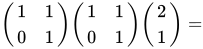
\begin{pmatrix}
1&1\\
0&1\\
\end{pmatrix}
\begin{pmatrix}
1&1\\
0&1\\
\end{pmatrix}
\begin{pmatrix}
1&1\\
0&1\\
\end{pmatrix}
\begin{pmatrix}
1\\
1\\
\end{pmatrix} =

\begin{pmatrix}
1&1\\
0&1\\
\end{pmatrix}
\begin{pmatrix}
1&1\\
0&1\\
\end{pmatrix}
\begin{pmatrix}
2\\
1\\
\end{pmatrix} =

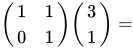
\begin{pmatrix}
1&1\\
0&1\\
\end{pmatrix}
\begin{pmatrix}
3\\
1\\
\end{pmatrix} =

\begin{pmatrix}
4\\
1\\
\end{pmatrix} =
b)

\begin{pmatrix}
3&1\\
2&8\\
\end{pmatrix}
\begin{pmatrix}
1&1\\
0&2\\
\end{pmatrix}
\begin{pmatrix}
1&1\\
0&1\\
\end{pmatrix}
\begin{pmatrix}
1\\
1\\
\end{pmatrix} =

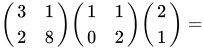
\begin{pmatrix}
3&1\\
2&8\\
\end{pmatrix}
\begin{pmatrix}
1&1\\
0&2\\
\end{pmatrix}
\begin{pmatrix}
2\\
1\\
\end{pmatrix} =

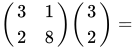
\begin{pmatrix}
3&1\\
2&8\\
\end{pmatrix}
\begin{pmatrix}
3\\
2\\
\end{pmatrix} =

\begin{pmatrix}
11\\
22\\
\end{pmatrix} =

3.


C = \begin{pmatrix}
1&2&3\\
4&5&6\\
7&8&9\\
\end{pmatrix}
\begin{pmatrix}
1&0&0\\
0&1&0\\
0&0&1\\
\end{pmatrix} =
\begin{pmatrix}
1&2&3\\
4&5&6\\
7&8&9\\
\end{pmatrix}

D = \begin{pmatrix}
1&0&0\\
0&1&0\\
0&0&1\\
\end{pmatrix}
\begin{pmatrix}
1&2&3\\
4&5&6\\
7&8&9\\
\end{pmatrix} =
\begin{pmatrix}
1&2&3\\
4&5&6\\
7&8&9\\
\end{pmatrix}

La chose importante à noter ici est que la matrice de 1 à 9 reste la même lorsqu'elle est multipliée avec l'autre matrice. La matrice composée uniquement de 1 sur la diagonale et 0 ailleurs est connue comme la matrice identité, notée I, et toute matrice multipliée d'un coté ou l'autre avec elle reste la même. C'est à dire A \times I = I \times A\,

4. a)

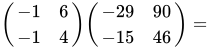
A^5 =
\begin{pmatrix}
-1&6\\
-1&4\\
\end{pmatrix}
\begin{pmatrix}
-1&6\\
-1&4\\
\end{pmatrix}
\begin{pmatrix}
-1&6\\
-1&4\\
\end{pmatrix}
\begin{pmatrix}
-1&6\\
-1&4\\
\end{pmatrix}
\begin{pmatrix}
-1&6\\
-1&4\\
\end{pmatrix} =

\begin{pmatrix}
-1&6\\
-1&4\\
\end{pmatrix}
\begin{pmatrix}
-1&6\\
-1&4\\
\end{pmatrix}
\begin{pmatrix}
-1&6\\
-1&4\\
\end{pmatrix}
\begin{pmatrix}
-5&18\\
-3&10\\
\end{pmatrix} =

\begin{pmatrix}
-1&6\\
-1&4\\
\end{pmatrix}
\begin{pmatrix}
-1&6\\
-1&4\\
\end{pmatrix}
\begin{pmatrix}
-13&42\\
-7&22\\
\end{pmatrix} =

\begin{pmatrix}
-1&6\\
-1&4\\
\end{pmatrix}
\begin{pmatrix}
-29&90\\
-15&46\\
\end{pmatrix} =

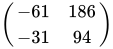
\begin{pmatrix}
-61&186\\
-31&94\\
\end{pmatrix}

b)


\begin{pmatrix}
1&-2\\
-1&3\\
\end{pmatrix}
\begin{pmatrix}
3&2\\
1&1\\
\end{pmatrix}
=
\begin{pmatrix}
(1 \times 3) + (-2 \times 1)&(1 \times 2) + (-2 \times 1)\\
(-1 \times 3) + (3 \times 1)&(-1 \times 2) + (3 \times 1)\\
\end{pmatrix}
=
\begin{pmatrix}
1&0\\
0&1\\
\end{pmatrix}

c) 
\begin{pmatrix}
a&b\\
c&d\\
\end{pmatrix}
\begin{pmatrix}
1&0\\
0&1\\
\end{pmatrix}
=
\begin{pmatrix}
(a \times 1) + (b \times 0)&(a \times 0) + (b \times 1)\\
(c \times 1) + (d \times 0)&(c \times 0) + (d \times 1)\\
\end{pmatrix}
=
\begin{pmatrix}
a&b\\
c&d\\
\end{pmatrix}

\begin{pmatrix}
1&0\\
0&1\\
\end{pmatrix}
\begin{pmatrix}
a&b\\
c&d\\
\end{pmatrix}
=
\begin{pmatrix}
(1 \times a) + (0 \times b)&(0 \times a) + (1 \times b)\\
(1 \times c) + (0 \times d)&(0 \times c) + (1 \times d)\\
\end{pmatrix}
=
\begin{pmatrix}
a&b\\
c&d\\
\end{pmatrix}

d)

A =
\begin{pmatrix}
3&2\\
1&1\\
\end{pmatrix}
\begin{pmatrix}
1&0\\
0&2\\
\end{pmatrix}
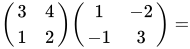
\begin{pmatrix}
1&-2\\
-1&3\\
\end{pmatrix} =

\begin{pmatrix}
3&4\\
1&2\\
\end{pmatrix}
\begin{pmatrix}
1&-2\\
-1&3\\
\end{pmatrix} =

\begin{pmatrix}
-1&6\\
-1&4\\
\end{pmatrix}

e) Comme exemple, je calculerai d'abord A^2\,

A^2 =
\begin{pmatrix}
3&2\\
1&1\\
\end{pmatrix}
\begin{pmatrix}
1&0\\
0&2\\
\end{pmatrix}
\begin{pmatrix}
1&-2\\
-1&3\\
\end{pmatrix}
\begin{pmatrix}
3&2\\
1&1\\
\end{pmatrix}
\begin{pmatrix}
1&0\\
0&2\\
\end{pmatrix}
\begin{pmatrix}
1&-2\\
-1&3\\
\end{pmatrix} =

\begin{pmatrix}
3&2\\
1&1\\
\end{pmatrix}
\begin{pmatrix}
1&0\\
0&2\\
\end{pmatrix}
\begin{pmatrix}
1&0\\
0&1\\
\end{pmatrix}
\begin{pmatrix}
1&0\\
0&2\\
\end{pmatrix}
\begin{pmatrix}
1&-2\\
-1&3\\
\end{pmatrix} =

\begin{pmatrix}
3&2\\
1&1\\
\end{pmatrix}
\begin{pmatrix}
1&0\\
0&2\\
\end{pmatrix}
\begin{pmatrix}
1&0\\
0&2\\
\end{pmatrix}
\begin{pmatrix}
1&-2\\
-1&3\\
\end{pmatrix} =

\begin{pmatrix}
3&2\\
1&1\\
\end{pmatrix}
\begin{pmatrix}
1&0\\
0&2\\
\end{pmatrix}^2
\begin{pmatrix}
1&-2\\
-1&3\\
\end{pmatrix} =

\begin{pmatrix}
3&2\\
1&1\\
\end{pmatrix}
\begin{pmatrix}
1^2&0\\
0&2^2\\
\end{pmatrix}
\begin{pmatrix}
1&-2\\
-1&3\\
\end{pmatrix} =

\begin{pmatrix}
3&2\\
1&1\\
\end{pmatrix}
\begin{pmatrix}
1&0\\
0&4\\
\end{pmatrix}
\begin{pmatrix}
1&-2\\
-1&3\\
\end{pmatrix} =

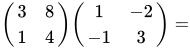
\begin{pmatrix}
3&8\\
1&4\\
\end{pmatrix}
\begin{pmatrix}
1&-2\\
-1&3\\
\end{pmatrix} =

\begin{pmatrix}
-5&18\\
-3&10\\
\end{pmatrix}

Maintenant, faisons les mêmes simplifications que j'ai fait précédemment avec A^5\,

 A^5 =
\begin{pmatrix}
3&2\\
1&1\\
\end{pmatrix}
\begin{pmatrix}
1&0\\
0&2\\
\end{pmatrix}^5
\begin{pmatrix}
1&-2\\
-1&3\\
\end{pmatrix} =

\begin{pmatrix}
3&2\\
1&1\\
\end{pmatrix}
\begin{pmatrix}
1^5&0\\
0&2^5\\
\end{pmatrix}
\begin{pmatrix}
1&-2\\
-1&3\\
\end{pmatrix} =

\begin{pmatrix}
3&2\\
1&1\\
\end{pmatrix}
\begin{pmatrix}
1&0\\
0&32\\
\end{pmatrix}
\begin{pmatrix}
1&-2\\
-1&3\\
\end{pmatrix} =

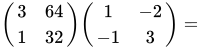
\begin{pmatrix}
3&64\\
1&32\\
\end{pmatrix}
\begin{pmatrix}
1&-2\\
-1&3\\
\end{pmatrix} =

\begin{pmatrix}
-61&186\\
-31&94\\
\end{pmatrix}

f)

 A^{100} =
\begin{pmatrix}
3&2\\
1&1\\
\end{pmatrix}
\begin{pmatrix}
1&0\\
0&2\\
\end{pmatrix}^{100}
\begin{pmatrix}
1&-2\\
-1&3\\
\end{pmatrix} =

\begin{pmatrix}
3&2\\
1&1\\
\end{pmatrix}
\begin{pmatrix}
1^{100}&0\\
0&2^{100}\\
\end{pmatrix}
\begin{pmatrix}
1&-2\\
-1&3\\
\end{pmatrix} =

\begin{pmatrix}
3&2\\
1&1\\
\end{pmatrix}
\begin{pmatrix}
1&0\\
0&1267650600228229401496703205376\\
\end{pmatrix}
\begin{pmatrix}
1&-2\\
-1&3\\
\end{pmatrix} =

\begin{pmatrix}
3&2535301200456458802993406410752\\
1&1267650600228229401496703205376\\
\end{pmatrix}
\begin{pmatrix}
1&-2\\
-1&3\\
\end{pmatrix} =

\begin{pmatrix}
-2535301200456458802993406410751&7605903601369376408980219232254\\
-1267650600228229401496703205373&3802951800684688204490109616122\\
\end{pmatrix}

Exercices sur les déterminants et les inverses

1.

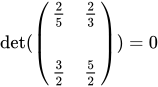
 \det(A) = \frac{2}{5} \times \frac{5}{2} -\frac{2}{3} \times \frac{3}{2} = 0

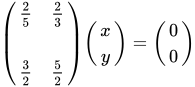
2. Le système d'équations sera traduit dans les matrices suivantes  \begin{pmatrix}\frac{2}{5}&\frac{2}{3}\\ \\ \frac{3}{2}& \frac{5}{2}\end{pmatrix}
\begin{pmatrix}x\\y\end{pmatrix}
=
\begin{pmatrix}0\\0\end{pmatrix} Parceque nous savons déjà que

 \det(\begin{pmatrix}\frac{2}{5}&\frac{2}{3}\\ \\ \frac{3}{2}& \frac{5}{2}\end{pmatrix}) = 0

Nous pouvons dire qu'il n'y a pas de solution unique pour ce système d'équations.

3. Calculons d'abord la valeur obtenue par la multiplication des déterminants


\det(
\begin{pmatrix}
a&b\\
c&d
\end{pmatrix}
)
\det(
\begin{pmatrix}
e&f\\
g&h
\end{pmatrix}
) =

(ad - bc)(eh - fg) =\,

adeh - bceh - adfg + bcfg\,

Maintenant, calculons C en faisant la multiplication matricielle d'abord


\det(
\begin{pmatrix}
a&b\\
c&d
\end{pmatrix}
\begin{pmatrix}
e&f\\
g&h
\end{pmatrix}
) =

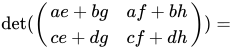
\det(
\begin{pmatrix}
ae+bg&af+bh\\
ce+dg&cf+dh
\end{pmatrix}
) =

(ae + bg)(cf + dh) - (af + bh)(ce + dg) =\,

aecf+bgcf+aedh+bgdh-afce-bgce-afdg-bhdg =\,

bgcf+aedh-bgce-afdg\,

qui est égal à la valeur calculée lorsque nous avons multiplié les déterminants, ainsi

det(C) = det(A)det(B)\,

pour le cas 2 x 2.

4.

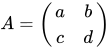
A =
\begin{pmatrix}
a&b\\
c&d
\end{pmatrix}

\det(A) = ad - bc\,
A' =
\begin{pmatrix}
c&d\\
a&b
\end{pmatrix}

\det(A') = cb - da\,

-\det(A') = -(bc - ad) = ad - bc\,

Ainsi det(A) = -det(A')\, est vrai.

5. a)

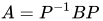
A = P^{-1}BP\,
\det(A) = \det(P^{-1})\det(B)\det(P) =\,
\det(P^{-1})\det(P)\det(B) =\,
\det{(P^{-1}P)}\det(B) =\,
\det{(I)}\det(B) =\,
\det(B)\, comme det(I) = 1\,.

ainsi det(A) = det(B)\,