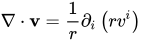
En coordonnées cylindriques, la racine carrée du déterminant du tenseur métrique vaut r et la divergence d'un champ de vecteurs s'écrit ∇ ⋅ v = 1 r ∂ i ( r v i ) {\displaystyle \nabla \cdot \mathbf {v} ={\frac {1}{r}}\partial _{i}\left(rv^{i}\right)} .
Dans la base naturelle, on a
v = v r e r + v ϕ e ϕ + v z e z ∇ ⋅ v = ( 1 r + ∂ ∂ r ) v r + ∂ ∂ ϕ v ϕ + ∂ ∂ z v z {\displaystyle {\begin{matrix}\mathbf {v} &=&v^{r}\mathbf {e} _{r}&+&v^{\phi }\mathbf {e} _{\phi }&+&v^{z}\mathbf {e} _{z}\\\nabla \cdot \mathbf {v} &=&\left({\frac {1}{r}}+{\frac {\partial }{\partial r}}\right)v^{r}&+&{\frac {\partial }{\partial \phi }}v^{\phi }&+&{\frac {\partial }{\partial z}}v^{z}\end{matrix}}}
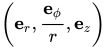
et donc dans la base orthonormée ( e r , e ϕ r , e z ) {\displaystyle \left(\mathbf {e} _{r},{\frac {\mathbf {e} _{\phi }}{r}},\mathbf {e} _{z}\right)} :
v = v r e r + { r v ϕ } { e ϕ r } + v z e z ∇ ⋅ v = ( 1 r + ∂ ∂ r ) v r + 1 r ∂ ∂ ϕ { r v ϕ } + ∂ ∂ z v z {\displaystyle {\begin{matrix}\mathbf {v} &=&v^{r}\mathbf {e} _{r}&+&\left\{rv^{\phi }\right\}\left\{{\frac {\mathbf {e} _{\phi }}{r}}\right\}&+&v^{z}\mathbf {e} _{z}\\\nabla \cdot \mathbf {v} &=&\left({\frac {1}{r}}+{\frac {\partial }{\partial r}}\right)v^{r}&+&{\frac {1}{r}}{\frac {\partial }{\partial \phi }}\left\{rv^{\phi }\right\}&+&{\frac {\partial }{\partial z}}v^{z}\end{matrix}}}
 .
.

 :
:



